Flower giving holidays around the world: a planner for 2027
Flowers keep a calendar of their own, and it doesn’t line up from one country to the next. Across the cities we deliver to, four occasions carry most of the year: Valentine’s Day on 14 February, International Women’s Day on 8 March, the many Mother’s Days, and a long season of teachers’ days that opens with the school year and runs into late November. Which of them matters for your bouquet depends on one thing: the calendar of the person who receives it.
That calendar can surprise you. Brazilians let 14 February pass and save their roses for 12 June. In Barcelona, a rose given on 23 April is answered with a book. In Rome, a single sprig of yellow mimosa is a complete gift for 8 March, while in Almaty or Moscow the same morning calls for a proper bouquet. And in China, couples have a date that is really a number: 520, read aloud, sounds close to “I love you.”
Below is the year from December 2026 to November 2027, a month at a time, followed by the stories behind the days that most often catch senders off guard and a few practical notes on ordering around the peaks.

The short answer: four peaks in a flower year
If you send flowers abroad only a few times a year, these are the dates worth keeping in your phone. On each of them, florists in many countries have their busiest days of the year.
February. Valentine’s Day, with red roses as the default. In 2027 it falls on a Sunday.
March. International Women’s Day, a public holiday in Russia and most of the CIS and one of the biggest flower days of their year.
May. Mother’s Day in most countries in 2027, though far from all of them.
Teachers’ season. From the first school assembly in Moscow to Teachers’ Day in Hanoi and Istanbul, bouquets travel to the front of the classroom.
Mother’s Day is the one most likely to trip you up, because it refuses to stay put. Indonesia keeps it on 22 December, Thailand on 12 August, Russia in late November (the 28th in 2027), and a large group of countries in May. Getting it wrong by a few weeks is easy, and a bouquet that arrives weeks early looks like a mix-up.
When to send flowers: a calendar month by month
The grid runs from December 2026 to November 2027. Holidays tied to the moon move every year, so treat their dates as this year’s answer rather than a rule.
- December 2026
- 22 Mother’s Day in Indonesia: flowers for mothers.
- January
- 7 Orthodox Christmas: flowers play a supporting role.
- 16 Teachers’ Day in Thailand, Wan Khru.
- February
- 6 Lunar New Year and Tết: plum and peach blossom, narcissus, orchids and kumquat trees for the home.
- 7–14 India’s informal Valentine’s Week, opening with Rose Day.
- 14 Valentine’s Day, on a Sunday: red roses.
- Graduations in South Korea: bouquets for graduates.
- March
- 3 Hinamatsuri in Japan: peach branches beside the dolls.
- 8 International Women’s Day, on a Monday: tulips, mimosa, roses.
- 14 White Day in Japan and Korea: sweets first, flowers as an extra.
- Graduations in Japan: bouquets for graduates.
- April
- 21 Administrative Professionals Day in the US: office bouquets.
- 23 Sant Jordi in Catalonia: a red rose and a book.
- May
- 9 Mother’s Day in most countries.
- 15 Teachers’ Day in South Korea: carnations.
- 20 China’s 520: roses between couples, informally.
- late Last Bell in Russia: graduates bring flowers to teachers.
- June
- 11 Shavuot in Israel: greenery, flowers, wreaths for children.
- 12 Dia dos Namorados in Brazil: roses.
- 20 Father’s Day in the US, UK and Canada: flowers are uncommon.
- Wai Khru in Thai schools, usually on a Thursday: trays of symbolic plants.
- July
- No big flower day on the calendar. Birthdays and anniversaries have the month to themselves.
- August
- 8 Qixi in China, on a Sunday: roses for a partner.
- 12 Mother’s Day in Thailand: jasmine.
- September
- 1 Day of Knowledge in Russia and the CIS: bouquets for teachers.
- 3 Teachers’ Day in Singapore.
- 5 Teachers’ Day in India.
- 10 Teachers’ Day in China: carnations and other flowers.
- October
- 1 Teachers’ and Mentors’ Day in Uzbekistan.
- 5 Teachers’ Day in Russia and Kazakhstan, and World Teachers’ Day.
- 20 Vietnamese Women’s Day: roses.
- 29 Diwali: marigold garlands.
- November
- 1–2 All Saints’ Day and Día de Muertos: offerings, not gifts.
- 20 Teachers’ Day in Vietnam.
- 24 Teachers’ Day in Turkey.
- 28 Mother’s Day in Russia.
Several of these days are informal. China’s 520 and India’s Valentine’s Week have no official standing at all, and White Day, Qixi and Sant Jordi are not public holidays either. That matters for delivery: on a weekday the recipient is probably at work, and the office may be the better address.
Valentine’s Day elsewhere: Sant Jordi, White Day and Qixi
Brazil barely notices 14 February. The date tends to land around Carnival, when the country has other plans, so Brazilians celebrate couples on 12 June instead. Dia dos Namorados is the eve of Saint Anthony’s Day, and Anthony is the saint people ask for a match. The holiday itself began as an advertising campaign in 1949, which hasn’t stopped it from becoming a fixture. It is not a public holiday, yet roses and gifts are expected. In 2027 it falls on a Saturday, so a home address is the safer bet.
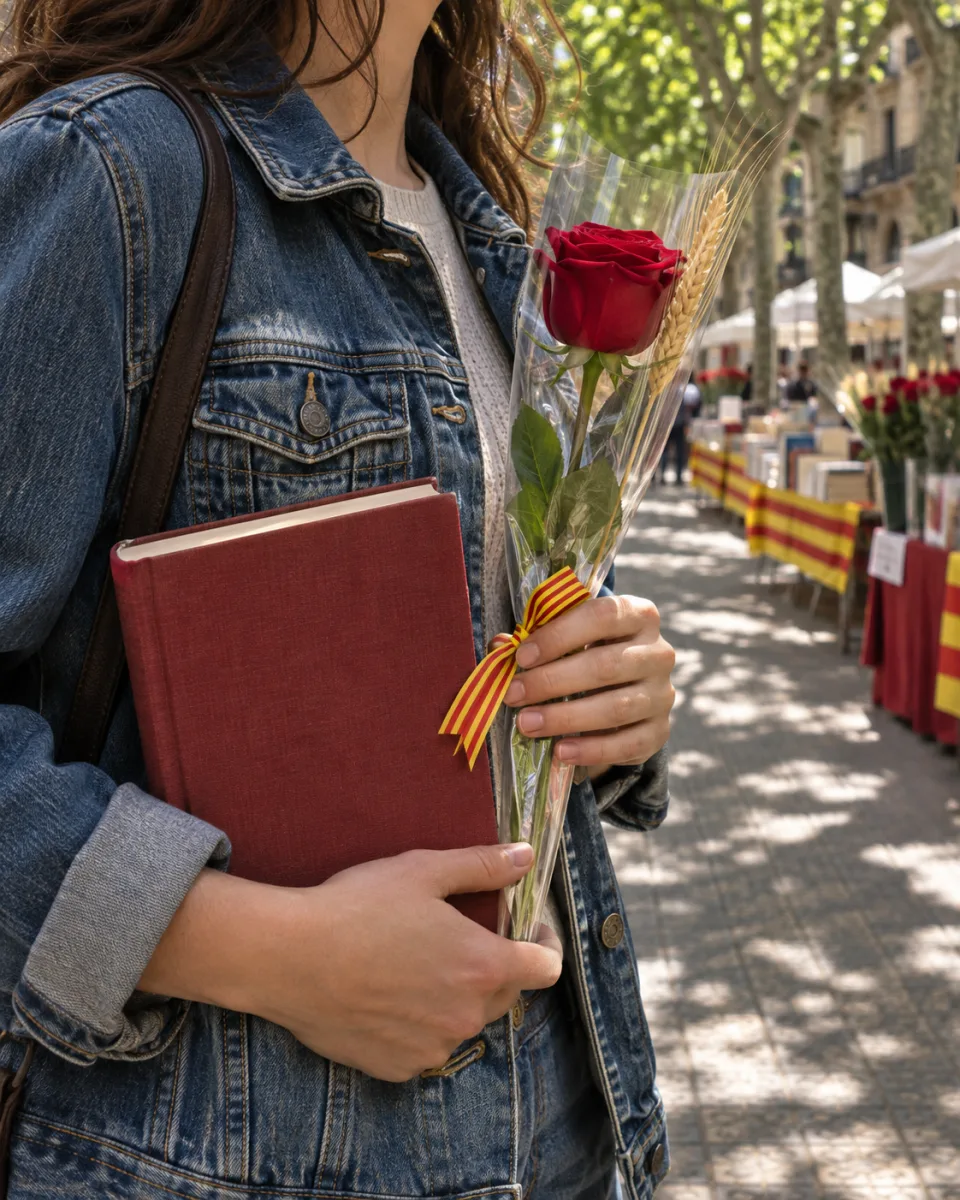
Catalonia keeps its own day of love on 23 April, the Diada de Sant Jordi, Saint George’s Day. The old pattern was tidy: a man gave a woman a single red rose, often with an ear of wheat, and she gave him a book. Today everyone exchanges both. The roses go back a long way, with records of the custom from the fifteenth century. The books are younger: the publisher Vicente Clavel proposed a book day in 1926, and it settled on 23 April around 1930 or 1931 (sources disagree on the year). The date has literary weight. Cervantes died on 23 April, and by tradition so did Shakespeare, and in 1995 UNESCO made it World Book and Copyright Day. If you are sending to Catalonia, one rose does the job, and a card that names a book does it better.
Japan splits the day in two. On 14 February it is traditionally women who give men chocolate. A month later, on White Day, men reply with return gifts, and the custom has spread to South Korea, Taiwan and China. Sweets come first, white chocolate especially. White Day flowers are an extra rather than the point, so a small bouquet sent alongside sweets fits the custom better than a large one sent instead.
China has two dates of its own. Qixi, the Double Seventh festival, falls on the seventh day of the seventh lunar month: 8 August in 2027. It is often called Chinese Valentine’s Day, though roses for a partner are a modern, commercial layer on a much older festival. Then there is 520, on 20 May, which has no legend and no holiday behind it, only three digits, wǔ-èr-líng, that sound close to wǒ ài nǐ, “I love you”. It belongs to the internet era, and couples mark it with roses and gifts.
India adds a week rather than a day. Valentine’s Week runs from 7 to 14 February and opens with Rose Day, followed by days for proposals, chocolate, teddy bears, promises, hugs and kisses. It is a marketing and youth custom with no official status, promoted mostly by greeting-card and retail sites, so treat it as play rather than obligation. Red roses carry most of these days, and if you want to know what they say, our note on what red roses mean settles it.
8 March: mimosa in Rome, tulips in Almaty
International Women’s Day is a modest affair in much of the West and an enormous one across the former Soviet Union. In Russia and most CIS countries it is a public holiday (Tajikistan keeps the date as its Mother’s Day), and in many families and offices every woman in sight gets flowers. Tulips, mimosa and roses dominate. In 2027 the day falls on a Monday, so the holiday sits on the date itself and most recipients will be at home.
Italy celebrates the Festa della Donna without a day off, and with a much smaller gesture: a sprig of yellow mimosa. The choice was deliberate. In 1946 the Unione Donne Italiane picked mimosa because it was cheap, grew wild and flowered in early March, so anyone could give it. A full mimosa bouquet is simply the generous version of the same idea.
China gives full-time female employees a half day off on 8 March, a rule that goes back to 1949. In practice it is common in the public sector and patchy in private firms. Vietnam marks two women’s days, 8 March and 20 October, the anniversary of the Vietnam Women’s Union. Neither is a public holiday, yet both are big flower days, mostly roses.
Ukraine needs a lighter touch. The date is still on the official calendar, but many Ukrainians now avoid it, and a card that cheerfully says “Happy 8 March” may land badly. A bouquet in early March with a card that simply speaks to the person is the kinder choice. For the wider rules on colors and stem counts, our guide to flower etiquette around the world goes through them.
Teachers’ Day flowers by country
In much of Asia and the former USSR, teachers are thanked with flowers on a fixed day, and those days are scattered from January to November.
| Country | Date in 2027 | What to know |
|---|---|---|
| Russia | 1 Sep, 5 Oct, late May | Bouquets at the first-day assembly, again on Teachers’ Day and at the Last Bell. |
| Kazakhstan | 5 Oct | A fixed date since 2023; it used to be the first Sunday of October. |
| Uzbekistan | 1 Oct | Teachers’ and Mentors’ Day, a public holiday. |
| South Korea | 15 May | Carnations, often made by students or given by the whole class. |
| China | 10 Sep | Carnations and other flowers; the day dates from 1985. |
| India | 5 Sep | The birthday of S. Radhakrishnan. |
| Singapore | 3 Sep | The first Friday of September, a school holiday, so the school may be empty. |
| Thailand | 16 Jan, June | Wan Khru in January; the Wai Khru ceremony early in the school year. |
| Vietnam | 20 Nov | One of the year’s big flower days. |
| Turkey | 24 Nov | Marks Atatürk’s 1928 title of Başöğretmen, “Head Teacher”. |
On 1 September, schools across Russia and the CIS hold an opening assembly, the lineyka, and children arrive with bouquets for their teachers. Gladioli are the stereotype, tall enough to hide a first-grader, though nobody has a convincing account of how they got the role. Recent advice in the Russian media is to pool for one bouquet per class, which spares the teacher an armful she can’t carry home. In Korea, an anti-graft law has narrowed what teachers may accept, so a carnation from a student is the safe form, and it’s worth asking the parents before sending anything larger.
Thailand’s Wai Khru, “paying respect to teachers”, is the most thoughtful of all. Students bring trays, called phan, to a ceremony early in the school year, usually on a Thursday in June. Each plant on the tray is a wish for the student, and the details vary a little between schools.
- Bermuda grass (ya phraek)
- It spreads stubbornly and comes back after mowing, so it stands for perseverance.
- Ixora (dok khem)
- Its name puns on “needle”, the wish for a mind as sharp as one.
- Eggplant flower (dok makhuea)
- The branch bows under its own weight, which makes it a sign of respect and humility.
- Popped rice (khao tok)
- Not a flower, yet always on the tray: it stands for discipline.
Festival flowers and flowers for the dead
Some of the year’s most flower-filled days have little to do with gifts. At Lunar New Year, Chinese homes fill with plum or peach blossom, narcissus, orchids and kumquat trees. In Vietnam’s Tết, northerners bring home branches of peach blossom (hoa đào) and southerners yellow apricot blossom (hoa mai). These flowers are for the house, or for the hosts of a New Year visit, so an orchid sent to a family before the holiday is the right gesture, and a romantic bouquet is not.
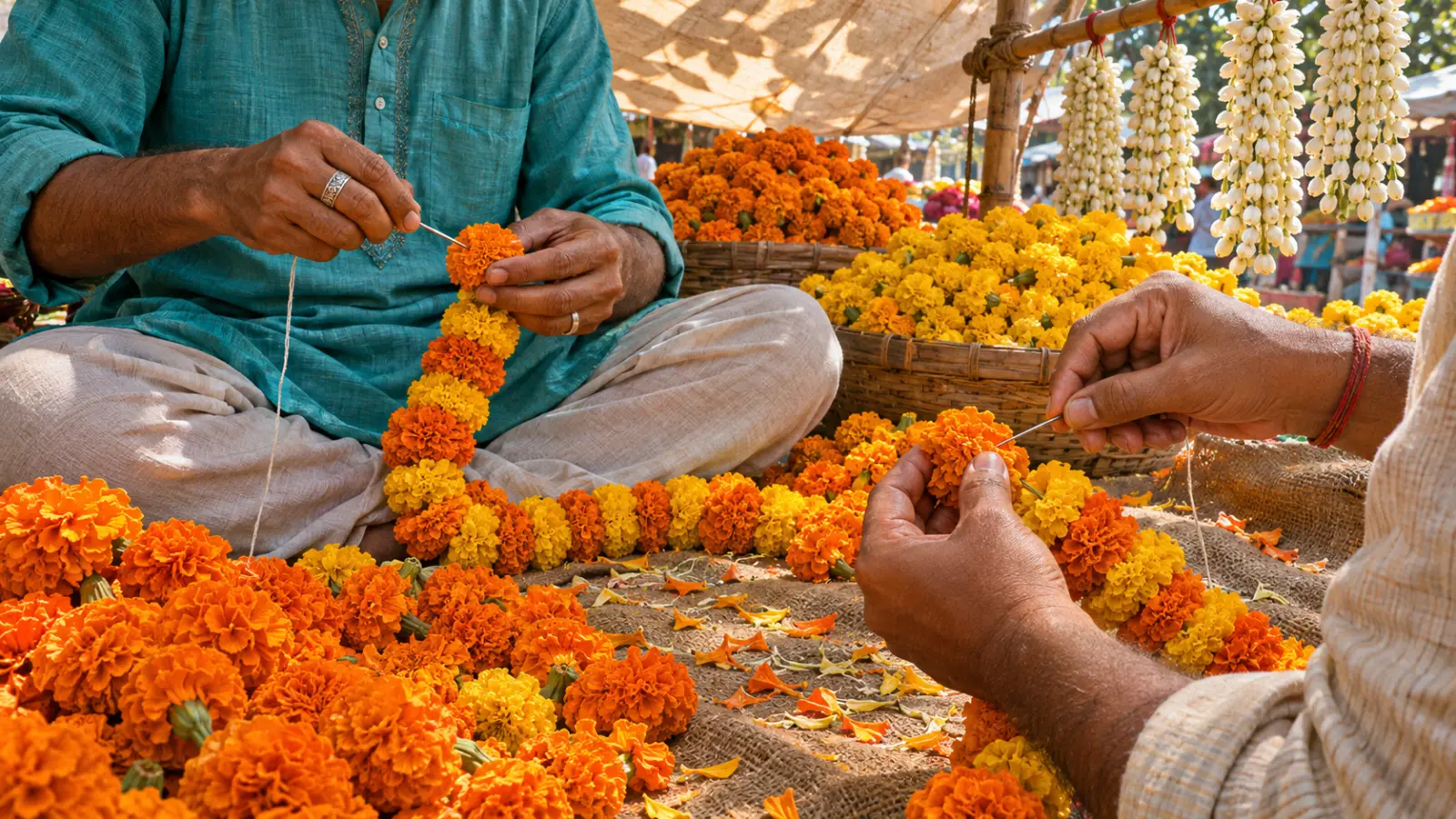
Diwali works the same way. For Lakshmi Puja on 29 October, homes are hung with garlands of marigold (genda) and door hangings called toran. Watch the time zone: on the US Pacific coast, the date can fall on 28 October. In Israel, Shavuot on 11 June is the one Jewish festival with a real flower custom; homes and synagogues are dressed in greenery and flowers, and children wear flower wreaths. Eid al-Fitr, expected on 9 or 10 March, has no religious flower custom, though flowers have become a modern extra in some places.
The first two days of November belong to the dead. In Mexico, families build home altars, ofrendas, and decorate graves with cempasúchil, the Mexican marigold, for Día de Muertos, which UNESCO recognized as intangible heritage in 2008. The flowers are offerings to those who have died, never gifts between the living. Across Catholic Europe and Latin America, 1 November is All Saints’ Day, another day of remembrance. If you want to mark these days for someone abroad, the tone is remembrance, and our guide to sympathy flowers across cultures explains what fits.
Planning around the peaks
On the big days, a florist in the recipient’s city makes your bouquet on the day of delivery, alongside the rest of that day’s orders. A few habits make the difference between a calm order and a hurried one.
- Start from their dateHolidays begin at midnight in the recipient’s time zone, not yours. A Valentine’s order placed on the evening of the 13th in New York is already late for Seoul. Our guide to sending flowers to another country covers addresses and time zones in detail.
- Order ahead of the peaksOn 14 February, 8 March, Mother’s Day and 1 September, florists’ schedules fill quickly. Placing yours a few days ahead leaves room for the bouquet you actually want.
- Check the weekdayIn 2027, Valentine’s Day and White Day fall on Sundays, 8 March on a Monday (a day off in Russia and most of the CIS), Sant Jordi on a Friday. Send to the office on workdays and to the home on weekends and holidays.
- Write the card for the cultureA card can go with the flowers, and it carries the date’s meaning: a White Day bouquet is a reply, a Sant Jordi rose wants a book, and for Ukraine a card works better without “8 March” on it.
- Look at the photoBefore delivery, we send you a photo of the bouquet, so you see it before the recipient does.
You choose the bouquet in your city, but the holiday happens in theirs.
The days without a bouquet
Some days on the calendar look like flower days and aren’t. Father’s Day falls on 20 June in the US, the UK and Canada, and flowers for men are not the custom there. If you want to send them anyway, our piece on flowers for men shows how to make the gesture feel natural. July, meanwhile, has no big flower day at all, which makes it a good month to send flowers for no occasion, when they arrive as a surprise rather than an obligation.