Mother’s Day around the world: dates by country and the flowers
Mother’s Day has no single date. The one that counts is the one kept in the country where your mother lives. In London it falls three weeks before Easter. In Bangkok it is August 12, in Moscow the last Sunday of November, and in most of the world the second Sunday of May. If you live in one country and she lives in another, go by her calendar, not yours.
From November 2026, the next dates come quickly. Russia celebrates on November 29. Indonesia marks Hari Ibu (Mother’s Day) on December 22. Then the cycle starts over in February: Israel’s Family Day falls on February 7, 2027, and Norway’s Morsdag comes a week later, which in 2027 puts it on Valentine’s Day. March is the busiest month outside May. Georgia, Britain and Ireland, the countries that fold mothers into March 8, and much of the Arab world all celebrate within three weeks of each other.
The table below sorts the dates by when they fall. After it come the reasons, and they are better than you might expect: a medieval church custom, an American daughter who came to regret her own success, an Egyptian newspaper column, and a Belgian city loyal to its patron saint. The stories are worth knowing because they also tell you which flowers are expected and whether anyone has the day off to receive them.

Mother’s Day dates by country
Three kinds of rule are at work. Some countries fix a calendar date, so the weekday changes from year to year: Mexico keeps May 10 whether it falls on a Tuesday or a Sunday. Others choose a Sunday, so the date moves and the weekday stays put. Britain and Ireland tie their day to Easter, which moves on its own schedule. The last column counts forward from November 2026.
| When | Countries | Next date |
|---|---|---|
| Last Sunday of November | Russia | Nov 29, 2026 |
| December 22 | Indonesia (Hari Ibu) | Dec 22, 2026 |
| 30 Shevat, Hebrew calendar | Israel, as Family Day | Feb 7, 2027 |
| Second Sunday of February | Norway | Feb 14, 2027 |
| March 3 | Georgia | Mar 3, 2027 |
| Fourth Sunday of Lent | UK, Ireland (Mothering Sunday) | Mar 7, 2027 |
| March 8 | Uzbekistan, Tajikistan, Azerbaijan, Moldova (shared with Women’s Day) | Mar 8, 2027 |
| March 21 | Egypt, UAE, Qatar, Saudi Arabia | Mar 21, 2027 |
| April 7 | Armenia (Motherhood and Beauty Day) | Apr 7, 2027 |
| First Sunday of May | Spain, Portugal, Hungary, Romania | May 2, 2027 |
| May 8 | South Korea (Parents’ Day) | May 8, 2027 |
| Second Sunday of May | USA, Canada, Brazil, Chile, Colombia, Peru, Cuba, Germany, Austria, Switzerland, Italy, Netherlands, Belgium (except Antwerp), Czechia, Denmark, Finland, Cyprus, Turkey, Ukraine, India, Sri Lanka, China, Hong Kong, Singapore, Japan, Australia, New Zealand, South Africa | May 9, 2027 |
| May 10 | Mexico | May 10, 2027 |
| Third Sunday of May | Kyrgyzstan | May 16, 2027 |
| May 26 | Poland | May 26, 2027 |
| Last Sunday of May | France and Monaco (moved to early June when it clashes with Pentecost), Sweden | May 30, 2027 |
| August 12 | Thailand | Aug 12, 2027 |
| August 15 | Antwerp, Belgium | Aug 15, 2027 |
| October 14 | Belarus | Oct 14, 2027 |
| Third Sunday of October | Argentina | Oct 17, 2027 |
A few places don’t fit a tidy row. In Kazakhstan, some reference books give the third Sunday of September (which would be September 19, 2027), but that date has no clear basis in law, and March 8 is the day people actually bring their mothers flowers. Vietnam marks the second Sunday of May in its cities, unofficially. The older occasion there is Vu Lan, a festival of filial devotion in the seventh lunar month, and Vietnamese Women’s Day on October 20 usually brings more flowers than either. The Seychelles have no national date, and families there tend to follow either the British date or the American one. For the rest of the year’s flower days, country by country, keep the world calendar of flower-giving days close by.
When is Mother’s Day in the UK? Mothering Sunday 2027
In the UK and Ireland the day is Mothering Sunday, the fourth Sunday in Lent, which always falls three weeks before Easter. Because Easter moves, so does Mothering Sunday: it was March 15 in 2026 and will be March 7 in 2027. This is the date most likely to catch you out. If your mother lives in Manchester or Cork and you live in Toronto, your local shops won’t mention Mother’s Day for another two months.
The British custom is much older than the American holiday. On the fourth Sunday in Lent, known as Laetare or Refreshment Sunday, people went back to their “mother church,” the main church of the place where they had grown up. Later, servants were given the day off to visit their home churches and their families, and so a visit to church gradually became a visit home.
Only in the twentieth century did Mothering Sunday take on the greetings and gifts of the American Mother’s Day, and the two customs, which had begun separately, merged. Many people in Britain now say “Mother’s Day” and mean the March Sunday, which is fine, provided you know which March Sunday it is this year.
What carnations mean on Mother’s Day
The May holiday that most of the world keeps goes back to Anna Jarvis. In 1908 she held the first Mother’s Day service in Grafton, West Virginia. In May 1914 Congress passed a law, and President Wilson proclaimed the second Sunday of May as Mother’s Day. Jarvis was particular about the apostrophe: Mother’s, singular, so that each family would honor its own mother rather than mothers in the abstract.
She chose the white carnation as the emblem of the day, and a second custom grew out of it. A red or pink carnation came to mean a mother who is living, and a white one a mother who has died. It is worth knowing this before you order. In the United States, and in Japan, where white was traditionally kept for the same purpose, a bouquet of all-white carnations can say something you never meant to say.
The rest of the story is less sweet. As the holiday grew, the price of white carnations rose every May, and Jarvis turned on the trade her idea had fed. In 1922 she backed a boycott of florists who raised their prices. In 1925 she was arrested for disturbing the peace while protesting carnation sales by the American War Mothers. She spent her last years trying to have the holiday abolished. It may seem odd for a flower service to tell you this, but she had a point: the day was meant for one particular person, and flowers matter only when they speak to her. If you want to know what other stems carry, our guide to what flowers mean sorts the folklore from the florist’s practice.
Her Mother’s Day is the one on the calendar by her front door.
Queens, saints and a newspaper column
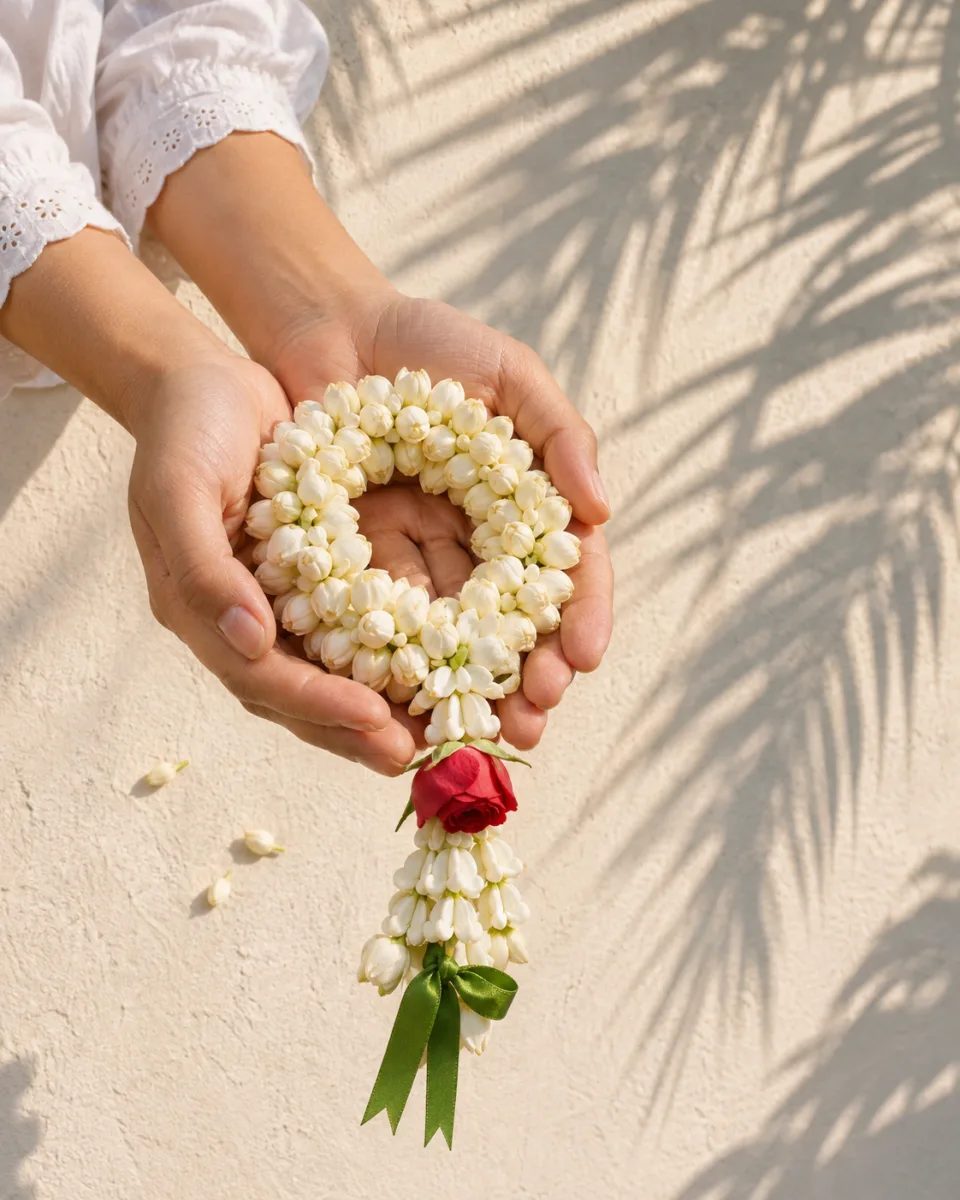
Thailand celebrates on August 12, the birthday of Queen Sirikit. The date was set in 1976; before that, the day fell on April 15. It is a public holiday. The same year, jasmine (dok mali in Thai) was named the official flower of the day. Its white is read as pure, lasting maternal love, and it is given as phuang malai, garlands strung from closed buds, rather than as a bouquet.
Across much of the Arab world, Mother’s Day, Eid al-Umm, falls on March 21, the spring equinox. Egypt marked it first, in 1956, and other Arab countries followed. The idea came from journalism: it is credited to the twin brothers Mustafa and Ali Amin of the newspaper Akhbar El-Yom, though some sources name one brother and some the other. Egypt, the UAE, Qatar and Saudi Arabia now share the date, and in none of them is it a day off.
Belgium keeps the second Sunday of May, with one exception. In Antwerp and parts of the surrounding province, such as the Kempen, Mother’s Day is August 15, the Feast of the Assumption. An alderman named Frans Van Kuyck introduced it in 1913, and the reasoning is local: the Virgin Mary is Antwerp’s patron saint. So two Belgian mothers can be celebrated three months apart.
South Korea made May 8 Mother’s Day in 1956 and widened it to Parents’ Day in 1973, so fathers share the occasion. It is a working day. Other dates have their own histories. Russia’s last Sunday of November was set by presidential decree in 1998. Yakutia had already kept a Mother’s Day of its own since 1993, in October, and no official reason was ever given for choosing November. Belarus has used October 14 since 1996, the Orthodox feast of Pokrov, the Intercession of the Theotokos. Indonesia’s December 22 marks the opening of the First Indonesian Women’s Congress in Yogyakarta in 1928. Israel widened its Mother’s Day into Family Day, held on 30 Shevat, the anniversary of the death of Henrietta Szold, who led Youth Aliyah and was called the “mother of all the children.”
Where March 8 still carries the flowers
If your mother lives in the former Soviet Union, the official Mother’s Day is often the smaller occasion. In Russia, International Women’s Day on March 8 is a public holiday and still the main day for flowers. The November Sunday is younger and, in many families, quieter. That works in your favor: a bouquet in late November arrives as a gesture of its own rather than a seasonal duty.
Elsewhere the two days have simply merged. Tajikistan officially renamed March 8 Mother’s Day in 2009, and it remains a public holiday. In Uzbekistan the same holiday serves women and mothers together, and Azerbaijan and Moldova generally honor mothers on March 8 as well. Georgia and Armenia keep both. Georgia celebrates mothers on March 3 and women five days later, which makes early March a busy week for anyone with a Georgian mother. Armenia has March 8 as well as April 7, Motherhood and Beauty Day, which coincides with the Armenian Church’s feast of the Annunciation. Ukraine marks the second Sunday of May and March 8 alike, and Romania, despite its own Ziua Mamei (Mother’s Day) in May, still saves its bigger flower day for March.
A few dates circulate that are best ignored:
- No
Mothering Sunday is the British date for the American holidayThe two began separately, centuries apart, and only merged in the twentieth century.
- No
Ukraine created its Mother’s Day in 2000The decree is dated May 10, 1999, and the day falls on the second Sunday of May.
- Unofficial
Kazakhstan celebrates in SeptemberThe date appears in reference books but has no clear legal standing. March 8 is the day that counts.
- No
The Seychelles use the last Sunday of MayThat date seems to belong to Mauritius. In the Seychelles people follow the British or the American date.
The flowers of the day
Only a handful of countries have a flower that belongs to Mother’s Day. Where such a flower exists, it helps to know it; where it doesn’t, you are free.
- White carnations
- Anna Jarvis’s original emblem. In the American custom that followed, white came to stand for a mother who has died. As a flower of remembrance it is a gentle gesture. Sent to a living mother in the US, it can look like a misunderstanding.
- Red and pink carnations
- The American flower for a mother who is alive and well. They don’t need to fill the bouquet: a few stems among roses or spray roses are enough to make the reference.
- Japan’s red carnations
- The customary gift for Haha no Hi (Mother’s Day), with white traditionally kept for a mother who had died. The confectioner Morinaga’s nationwide campaigns from 1937 helped make the day popular.
- Korea’s pinned carnation
- On Parents’ Day the carnation is worn, not put in a vase. A son or daughter pins it on and hands over a letter, so in Korea the words matter as much as the flower.
- Thai jasmine
- The official flower of Thailand’s Mother’s Day, given as a phuang malai garland. If you are sending a bouquet from abroad, white flowers echo the custom without trying to imitate it.
- Her own favorites
- Everywhere else, memory outranks symbolism. If she has always kept peonies on the table or had a weakness for freesia, that will mean more to her than any flower on this list.

Mother’s Day aside, some countries hold firm views on colors and on the number of stems, and a bouquet that would be cheerful in one place can be awkward in another. Our guide to flower etiquette around the world covers the customs worth checking before you choose.
Sending flowers to your mother in another country
Flowers from abroad don’t actually travel. With international flower delivery through jfloo, you place the order and a partner florist in your mother’s city arranges the bouquet on the day and takes it to her door. So the flowers are as fresh as any bought around the corner. What you need to get right is the timing and the words.
- Find her dateUse the table above, not the shop windows where you live. In March or August your own city may be months away from Mother’s Day while hers is next weekend.
- Count in her time zoneThe day begins when it begins for her. If you live eight hours behind, her Sunday morning is your Saturday evening, so place the order with her clock in mind.
- Order earlyMother’s Day weekend is one of the busiest of the year for florists almost everywhere. An early order leaves room to choose the flowers and to adjust the details.
- Check whether it’s a day offSunday dates are simple. Fixed dates often fall on working days: May 10 in Mexico is not a federal holiday, May 26 in Poland is not a public holiday, and Korea’s Parents’ Day is a working day. Find out whether she’ll be at home or at work.
- Write the card in her languageA short message in the language she thinks in carries further than a long one in yours. Before delivery we send you a photo of the bouquet, so you see it before she does.
Payment is by bank card or PayPal. If anything is wrong with the bouquet, write to us within 24 hours with a photo and we will sort it out. For the practical side in more depth, including addresses and recipients who move around, see how to send flowers abroad.
A day without a calendar
Behind all these dates sits one plain fact: people wanted a day set aside to say what they usually leave unsaid, and every country chose the day that made sense to it, a church Sunday, a queen’s birthday, a saint’s feast, a line in a decree. None of them is more correct than the others. If you live far from your mother, the calendar is mainly a reminder. What she will remember is that the flowers came on her day, in her city, with your words on the card.