Sympathy flowers etiquette: what to send when you can’t be there
When someone you love is grieving in another country, the first thing you feel is the distance. You can’t sit with them in the kitchen, answer the door for them or carry chairs in from the neighbors. Flowers seem like the one thing that can travel in your place, and often they can. But mourning keeps its own rules, older than any florist’s catalog, and they differ sharply from one family to the next.
The short answer is this. Read the death notice first, or ask someone close to the family. If you still don’t know their faith or their wishes, send a modest arrangement to the home rather than to the funeral, in white or soft colors, with a few plain lines on the card. If the notice asks for donations, or the family is Jewish, or Muslim and observant, food or a gift to charity in the person’s name is usually the kinder choice. In grief, the gesture matters more than the bouquet.
Everything below is about reading a room you can’t walk into: what the notice is telling you, how traditions differ by faith and country, and what to send when flowers aren’t the answer at all.
Before you order
Four small checks will spare you most of the mistakes people make with sympathy flowers. None of them takes long, and most of them happen before you choose a single stem.
- Read the notice closely“Family flowers only” means that only the family’s own tributes go to the service. “No flowers,” “donations preferred” and “in lieu of flowers” mean exactly what they say: give to the cause named, send a card or offer help.
- Ask one person who knowsA mutual friend, a colleague or a cousin can tell you in a sentence whether the family keeps a religious tradition and whether flowers would be welcome. If the notice is unclear, ask the funeral director before ordering.
- Choose home or venueFlowers for the service follow the family’s and the funeral director’s arrangements. Flowers for the home are a private gesture. Many guides suggest that a small posy can go to the house even when the service is “family flowers only,” though not every family will welcome it, so ask if you can.
- Keep the card shortThe person’s name, one memory and one offer of help you will actually give. Leave the eloquence for the letter you write later.
The home address is the gentler choice for another reason too. A funeral lasts a morning. The house is where the family lives with the loss in the weeks that follow, when the visitors have gone back to their own lives and a vase on the table is still being looked at every day.
Funeral flowers by religion and country
These are broad lines, and families inside any faith differ. A secular family in a religious country may do things its own way, and an observant family abroad may keep customs more strictly than relatives at home. Treat what follows as a guide to the right question to ask the family or a friend.
Russian Orthodox and post-Soviet
Russia · The wider post-Soviet world
Even numbers are for the dead and odd numbers for the living, and this is the one rule worth checking twice: count the stems. Mourners place fresh flowers in the coffin, always an even number, and these are removed before burial. In many families the usual choice at modern funerals is carnations or roses; the colors vary by family, so if you’re unsure, ask.
UK, US and Sweden
United Kingdom · United States · Sweden
The death notice does most of the work here, and its wording is meant literally. In Sweden, mourners often give a minnesgåva (memorial gift) instead of flowers, to a cause named in the notice; church flower funds, blomsterfonden, collect these gifts.
Catholic Europe
France · Italy · Poland
Chrysanthemums are the flower of the dead. In France the custom dates from November 1919, when graves and war memorials were decorated for the first Armistice anniversary, and chrysanthemums were chosen because they still bloom in November. In Poland, families visit graves on Wszystkich Świętych (All Saints’, November 1) and Zaduszki (All Souls’, November 2) with chrysanthemums and znicze, votive candles in glass. Italy keeps Ognissanti on the same dates. Never give a chrysanthemum to the living in France; in Italy, folk belief says the same.
Jewish families
Jewish families worldwide · Israel
So can you send flowers to a Jewish funeral? Traditionally, no. Flowers are not part of Jewish mourning, most rabbis discourage them, and they don’t belong in a shiva house during the first seven days. Send food that needs no preparation (kosher, if the home keeps kosher) or give tzedakah, charity in the person’s memory. At Israeli secular funerals and state ceremonies flowers and wreaths are common, though many religious Jews still object, and Reform families abroad vary. Visitors to a grave leave a small stone, a sign that someone came.
Muslim families
Muslim families worldwide
Burial should take place as soon as possible, ideally within 24 hours, so flowers ordered for the funeral may simply arrive too late. Flowers on graves are disputed: some scholars call them an innovation, others (notably in parts of South Asia) allow them, and practice differs by country and community. Food is the gesture with the clearest footing. Sending food to the bereaved family is Sunnah, the Prophet’s practice, and the guidance is that neighbors and relatives do the cooking, not the family. Charity in the person’s name is a common alternative.
Hindu families
India · Hindu families abroad
Flowers belong to the rites themselves: garlands and blossoms, including white marigolds, roses and jasmine, are placed on and around the body. White is the color of mourning. A garlanded photograph of the person is often kept at home during the mourning period, which commonly lasts 13 days, though some families keep 10, 12 or 16.
Japan, China, Hong Kong and Korea
Japan · China · Hong Kong · Korea
Here condolence money in an envelope matters as much as any flower. In Japan it is kōden, given in a kōdenbukuro envelope with used banknotes, since crisp new ones suggest the death was expected. In China and Hong Kong it is bai jin (“silk money”) in a white envelope, toward the cost of the funeral; in Korea, jouigeum, also in white, written in black ink only. At Korean funerals mourners lay a white chrysanthemum at the altar with the blossom toward the portrait. Funeral flowers in Japan and China are generally white chrysanthemums, with lilies on Japanese stands, and red is avoided. If you can’t attend, a condolence telegram to a Japanese family is the accepted gesture.
Two more customs are worth knowing. In Thailand, funeral wreaths, phuang rit, arrived from the West (the first recorded use was at a royal cremation in 1904), and organizations send them routinely; a growing number are made of electric fans or fabric that go to a temple or to people in need once the cremation is over. In Mexico, the orange cempasúchil marigolds of Día de Muertos (November 1–2) dress the home altar and mark a path for souls, but that is a festival of remembrance, not a funeral. After a death, families hold a velorio (wake), a funeral Mass and nine nights of rosary prayer, with flowers and candles throughout. For everyday flower customs beyond mourning, see our guide to flower etiquette around the world.
What to send instead of flowers
Sometimes the right gesture is something to eat, something given away in the person’s name or a letter written by hand. In several of the traditions above it is the expected choice, and in a house full of grief, help that removes a chore is often worth more than anything that needs a vase.

Instead of flowers
- Food that needs no cooking: something ready to eat or simply reheat, kosher for a kosher home.
- A donation to the cause in the notice, or to one the person cared about, made in their name.
- A real letter, with a memory the family may not know.
- Practical help with a date attached: a form you can translate, a call you can make, a friend nearby you can send over.

When flowers are welcome
- The notice invites them, or says nothing and the family’s friends confirm it.
- The family is Orthodox, Catholic, Protestant or secular, and you’ve checked the count and the colors.
- Hindu families, where flowers are part of the rites (ask before sending to the home).
- Later, at home, once the funeral is over and the first wave of visitors has passed.
If you’re torn, choose the gesture the family asked for, even if it feels less personal to you. A donation made as requested tells the family you listened.
What to write on a sympathy card
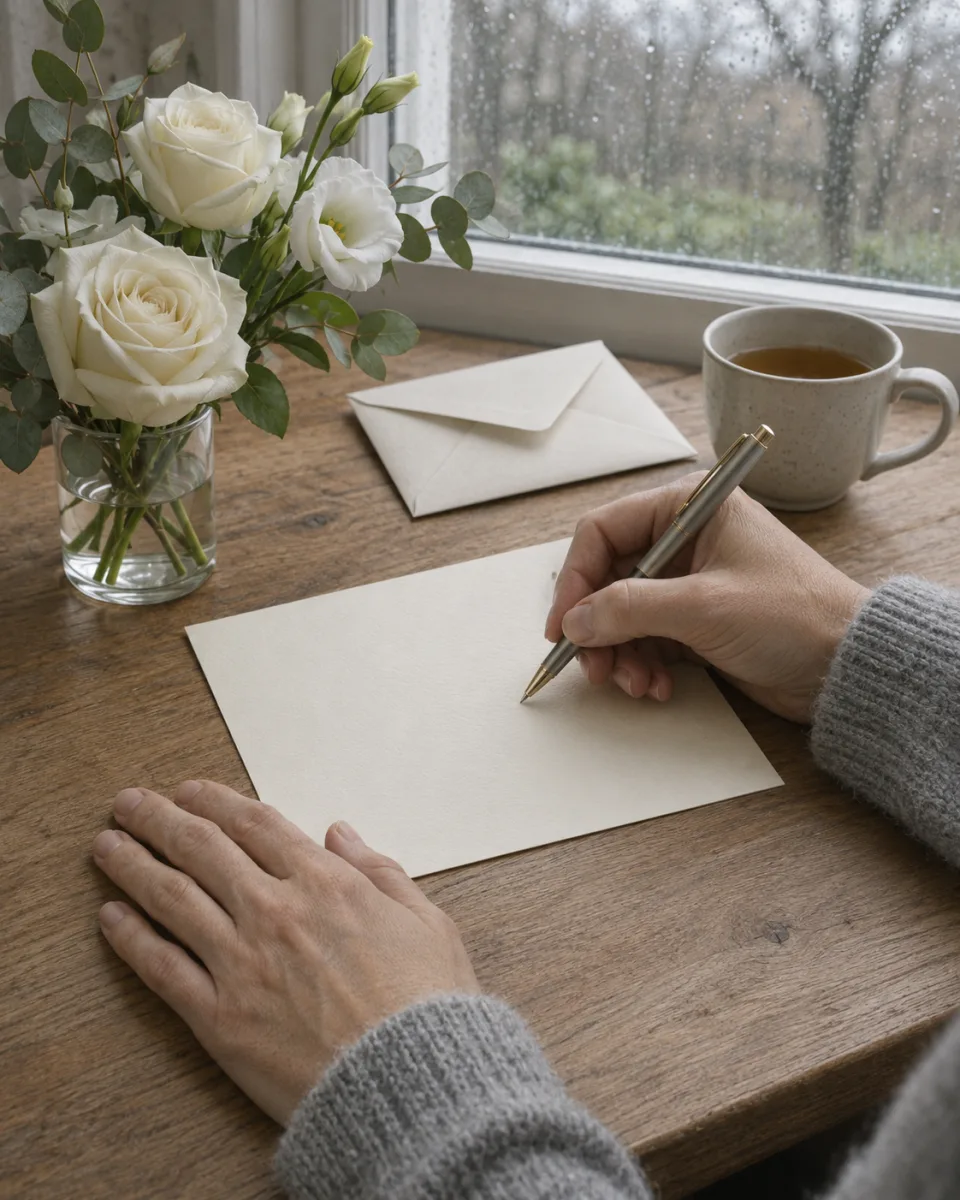
A sympathy card works best when it is short and sounds like you. Use the person’s name, because grieving families notice when it’s missing. Add one memory, however small, and if you offer help, make it specific and make it something you will really do.
Some phrases hurt even when they’re meant kindly. “Everything happens for a reason” asks the family to agree with you. Anything that begins with “at least” shrinks the loss. “I know how you feel” isn’t true, since no two losses are the same, and “be strong” hands the bereaved one more job. Leave out silver linings altogether, and don’t promise help you won’t give.
Religious wording belongs on the card only when you know the family’s faith. “May Allah grant him peace” is right for a Muslim family and out of place elsewhere; if you’re unsure, “With deepest sympathy” is a safe line. When flowers go with a card, the card is the part written in your own words, so take the extra minute. Our guide to what to write on a flower card has more wording for difficult occasions.
I’m so sorry about your dad. I keep thinking of the summer he tried to teach us all to fish. I’ll call on Sunday, and every Sunday after, if you’d like.
We were so sorry to hear about your mother. Please take all the time you need. Your work is covered until you’re ready.
With deepest sympathy. Elena was kind to me when I was new and lost, and I have never forgotten it.
May Allah grant him peace. Your family is in our thoughts and prayers.
Later, not only now
The first days after a death are crowded. Then the house goes quiet, and that is often when a card or a small bouquet means most. Many traditions mark particular days after a loss, and knowing them gives you a natural moment to reach out again.
| Tradition | Days that are marked | A gesture that fits |
|---|---|---|
| Russian Orthodox | Memorial meals, pominki, on the funeral day, the 9th and the 40th day | A call or a modest bouquet for the home, even in number |
| Jewish | Shiva, the first seven days; public mourning pauses on Shabbat and festivals | Food during shiva, charity in the person’s memory |
| Sunni Muslim | Three days of mourning; a widow observes a longer period | Food for the family, charity in the person’s name |
| Hindu | Commonly 13 days, then shraddha rites and yearly observances | A letter or a call when the mourning period ends |
| Japanese | The 49th-day observance | A visit before it, if you couldn’t attend; no New Year cards that winter |
| Any family | The first anniversary, the person’s birthday | A note that says you remember the date |
In the Orthodox tradition the 9th and 40th days carry real weight: relatives order a service from a priest, and folk belief holds that the soul stays on earth for up to forty days. A message that arrives then, from someone far away, lands on a day the family is already thinking hard about. A bouquet sent in the sixth week, when the others have long been cleared away, tends to be the one people remember.
Sending sympathy flowers from abroad
When you order through jfloo, the flowers never cross a border. A partner florist in the recipient’s city arranges them on the day of delivery, so what arrives at the door is fresh and made locally. Before delivery we send you a photo of the arrangement, so you see it before the family does, and a card with your own message goes with the flowers.
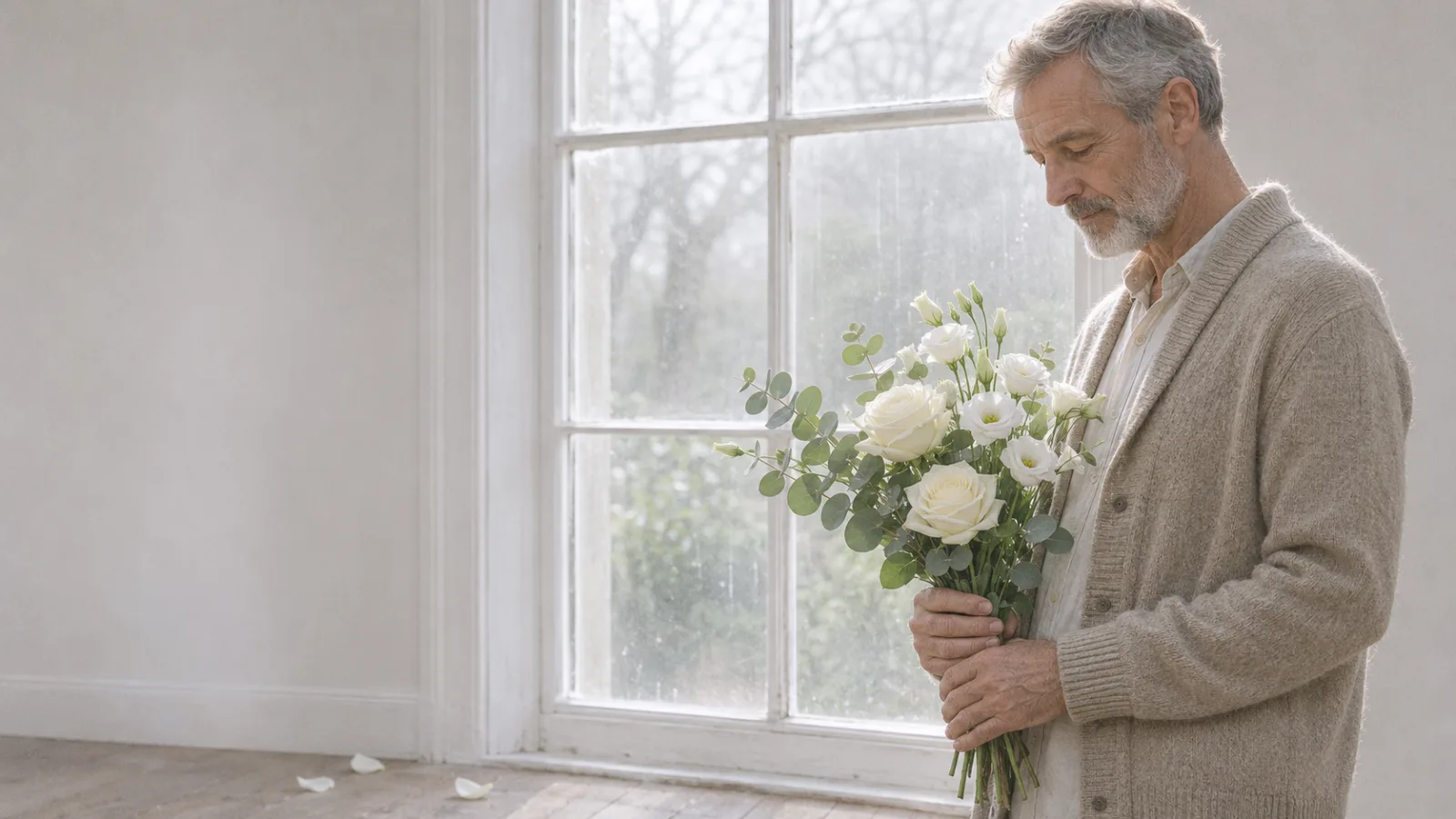
A few practical points make sympathy deliveries go more gently. Send to the home rather than aiming at a service whose time and place may change, and for a Muslim family remember that the burial may already have happened. Ask a friend on the spot whether someone will be in. Keep the arrangement small and quiet: white roses, lisianthus, soft greenery. Our note on what white roses mean explains what they are often taken to say, and the wider practicalities are in our guide to sending flowers to another country.
What stays
Families may not remember which flowers came or how large the arrangement was. They remember who wrote, who asked what they needed, who sent soup in the second week and who called on the fortieth day. If you have read the notice, asked the one question that matters and written three honest sentences, you have already done the hard part, whatever you end up sending.