Barbara branches: cherry twigs cut on December 4 that bloom by Christmas
Cut a cherry branch on December 4, give it water and warmth, and there is a fair chance it will be in flower on Christmas Eve. Cherry and plum twigs usually need about two to three weeks indoors to open, which is why the custom puts the cut on Saint Barbara’s Day: twenty days later it is December 24. Whether yours blooms depends on things you can control: a branch with fat flower buds, a spell of frost before you cut it, a long slanting cut, lukewarm water and a room that is warm but never hot.
In Germany and Austria they are Barbarazweige, in Czechia barborky, and in English simply Barbara branches. They make a small, quiet ritual for the darkest weeks of the year: a few bare sticks in a jug on the kitchen table that turn, slowly enough to watch, into something that looks like April.
If you would rather aim for New Year’s Day or for Orthodox Christmas on January 7, the countdown table further down shifts the cutting dates for you.
The legend of Saint Barbara and her cherry twig
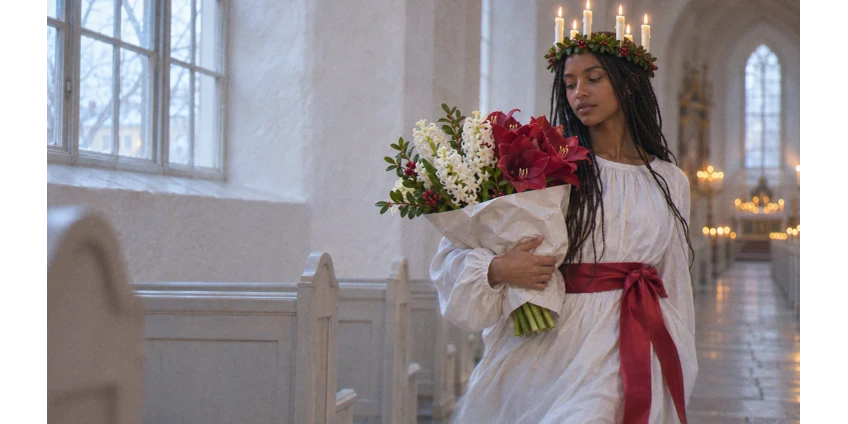
Saint Barbara belongs to legend rather than to documented history, and the Church says so itself. In 1969 she was removed from the General Roman Calendar because her story could not be shown to be historical. She remains in the Roman Martyrology on December 4, and her day is still kept locally.
The story runs like this. Barbara was the daughter of a pagan nobleman in Nicomedia, in what is now Turkey. Her father shut her in a tower, where she became a Christian in secret and had a third window cut into the wall, for the Trinity. When he found out, he handed her over to the authorities and in the end beheaded her himself. In the German telling he is struck by lightning on the spot. Barbara is the patron of miners, artillerymen and firefighters, and one of the Fourteen Holy Helpers, invoked against lightning and sudden death.
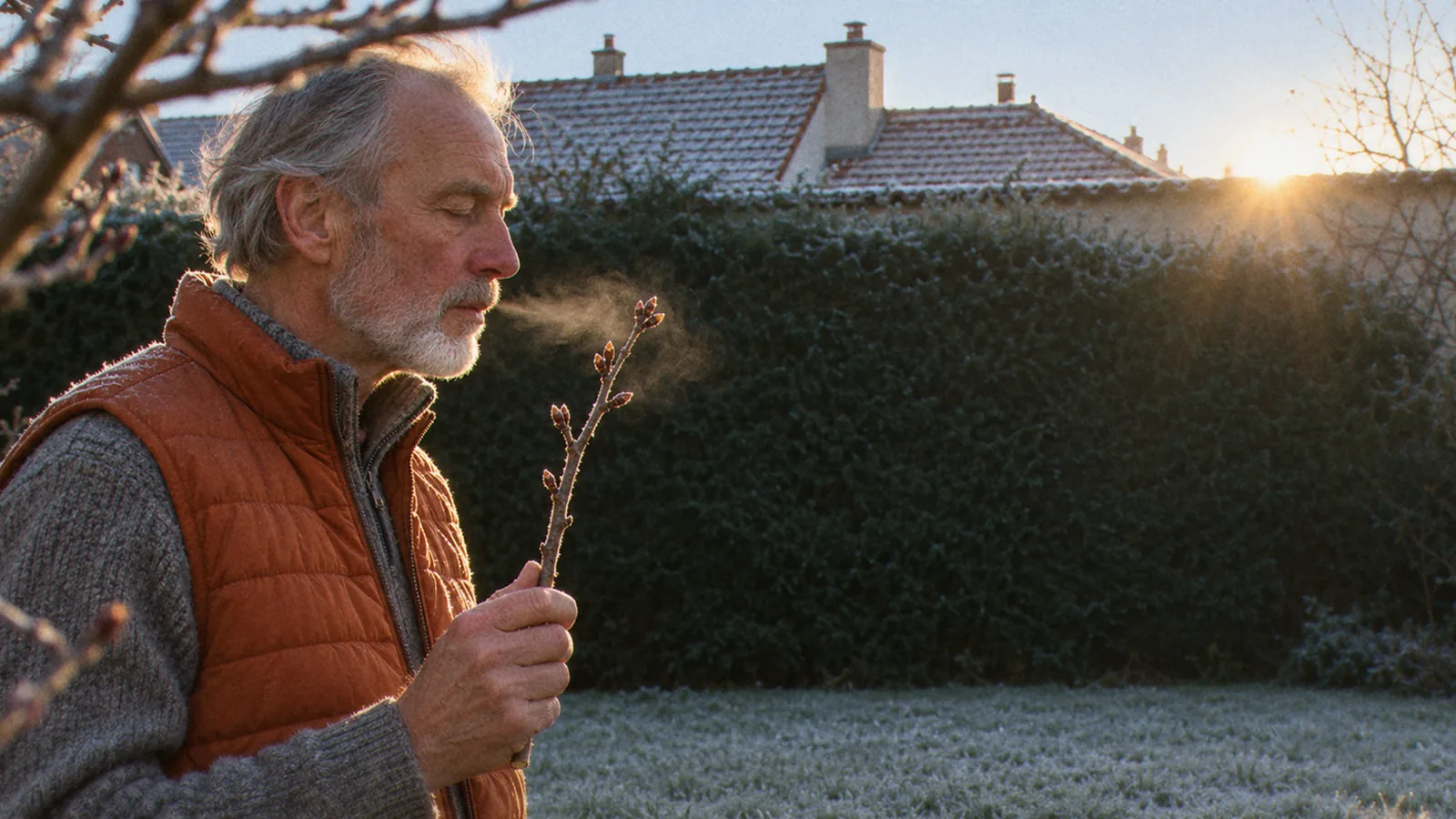
The branches come from a smaller detail. On her way to prison, a cherry twig caught in her dress. She kept it in her cell, watered it from her drinking cup, and it blossomed on the day she died. The versions differ in the particulars.
A Barbara branch is an Advent calendar you can water.
Why cut cherry branches on December 4?
The date is practical as much as pious. Twenty days separate December 4 from Christmas Eve, and that sits comfortably inside the two to three weeks a cherry branch takes to open in a heated room. Folklore then gave the blossom a meaning. A branch in flower at Christmas promises luck for the coming year. A girl whose twig blooms by Christmas Eve will be married within the year, and in some places each twig was named after a suitor, so that the first to flower pointed to the groom.
Germany and Austria
Berlin · Vienna · Salzburg · Styria
Cherry is the classic Barbarazweig, though old Viennese households also cut other fruit trees and sometimes birch. Vienna kept some charming extras: branches sold with lottery numbers, and in Favoriten a name slip hung on a twig for each member of the family. Some Salzburg tellings read the blossom for a birth or for wealth.
Czechia
Prague · Bohemia · Moravia
Here the twigs are barborky, and traditionally unmarried girls cut them, on December 4 or the evening before. Cherry or sour cherry is usual, sometimes apple or plum. The target is Štědrý den, literally “the generous day,” which is Christmas Eve.
Switzerland
Zürich · Bern · Basel
The custom is known, and Swiss media cover it in December, but how widely it is kept is unclear.
Hungary and Poland
Hungary · Cieszyn Silesia
Hungarian folklore recorded a cherry branch set in water on Borbála-nap (Barbara’s day) as a marriage sign, and west of the Danube as a sign of luck and health, though it is mostly described in the past tense. In Poland, Barbórka is chiefly the miners’ holiday, with girls cutting cherry or lilac twigs in some regions.
None of this asks for belief. You can keep the custom simply as a reason to notice the days passing. The branches sit well beside an Advent wreath and its four candles, and they are one of many winter customs in our round-up of Christmas flowers around the world.
Which branches bloom indoors, and how long they take
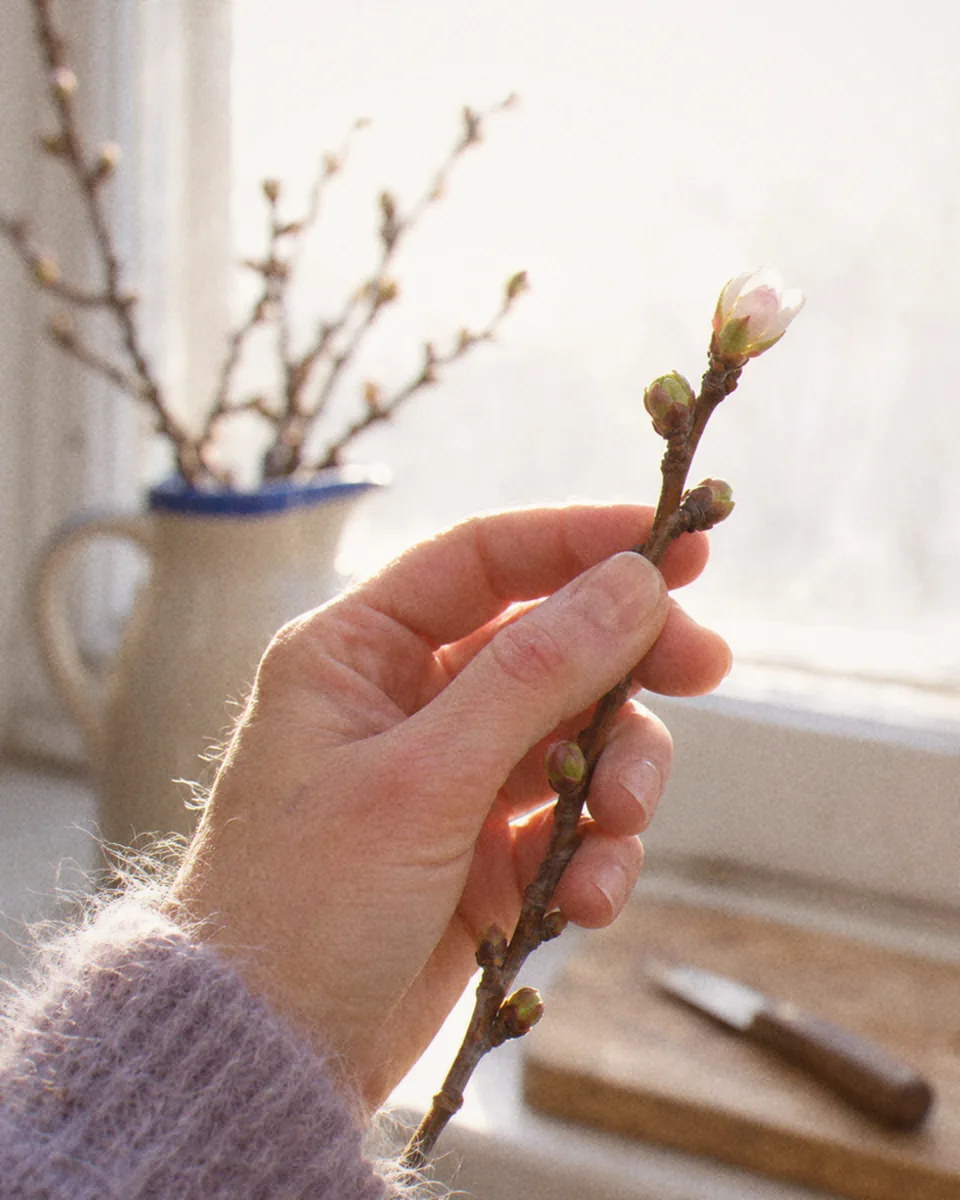
In December a fruit tree is dormant, its buds closed and waiting for spring. Bring a branch into a warm room and you persuade it that spring has come early. Cherry is the classic choice, and sour cherry and plum behave in much the same way.
What you cut matters more than anything you do afterwards, so look closely before you reach for the secateurs. Flower buds are fat and round; leaf buds are slimmer and pointed. Pick young shoots that are well set with round buds, and skip old wood, which carries few flowers. Take a few branches from your own garden, or buy them at a market or from a florist. Do not cut them in the wild or in a park.
The times below are ranges, and in December they lean long. Forcing time depends on the species and on how close the cut is to natural flowering: a branch cut in late winter can open quickly, while the same tree cut in early December needs more patience. A warmer room speeds things up and a cooler one slows them down.
| Branch | Time indoors | What to know |
|---|---|---|
| Cherry, sour cherry | About 2–3 weeks in German guides; US extension guides give 2–4 weeks for late-winter cuts | The classic Barbara branch. Expect the slow end in December. |
| Plum | About 2–3 weeks in German guides; 3–4 weeks in US guides | Behaves much like cherry, often a touch slower. |
| Cornelian cherry (Cornus mas) | About 7–10 days, by one German gardening guide | Fast, but the figure rests on a single source. Allow for it running longer. |
| Forsythia | 7–10 days by the same guide; 1–3 weeks by US extension advice | A good backup if you missed December 4. |
| Apple | About 2–4 weeks in US extension guides | Harder to force this early, and its flower buds are easy to mistake for leaf buds. |
| Hazel, blackthorn, pear, quince, lilac, peach, flowering currant | No dependable figures | All are suggested for Barbara branches. Treat them as an experiment. |
Why the branches need a frost first
A fruit tree in December is not simply waiting for warmth. Its buds are dormant, and dormancy is a lock that cold opens: woody plants need several frost nights before their buds will respond to warmth at all. NABU, Germany’s nature conservation union, says a few frost days are enough, but notes that in some regions they have not arrived by early December. A branch cut after a mild autumn can stand in its jug for weeks looking exactly as it did on the first day.
If there has been no proper frost where you live, German gardening advice offers a stand-in: the freezer. The recommended time varies from one night (Ökotest) to about a day (Utopia) to one or two days (NABU, and two days in Gartenjournal). None of them gives a temperature, and none promises results. Treat the freezer as an imitation of winter rather than a guarantee, and follow it with a long drink of lukewarm water.
Time the cold so that it comes before the cut. German guides say never to cut while the wood is frozen, and American extension advice is to cut when the temperature is above 0 °C. If your branches came in frozen through, lay them in water for a few hours to thaw before you do anything else.
How to force cherry branches to bloom indoors
- Cut on a mild dayUse sharp secateurs or a knife and make a long, slanting cut, which gives the stem more surface to drink through. Gartenjournal also suggests tapping or slitting thick stems at the base.
- Give them a warm drinkNABU lays the branches in lukewarm water overnight before moving them to a vase of fresh water; Gartenjournal suggests about 35 °C for the stem ends.
- Start cool, then bring them into the roomIowa State’s extension service keeps forced branches cool (16–18 °C) and in dim light at first, then moves them somewhere bright once the buds open. Gartenjournal settles on a bright spot at 18–22 °C, out of direct sun.
- Keep them away from the radiatorHeat dries branches out, and dry buds shrivel instead of opening. Avoid a windowsill above a radiator.
- Change the water and mistGerman guides change the water every 2–4 days; American ones say daily. Mist the branches too: Gartenjournal says lightly, Iowa State two or three times a day.
Old Viennese households did one thing differently: they never changed the water at all. It makes a nice fact for a card, but modern advice is to change the water regularly. The same principles that keep any bouquet fresh apply here, and our guide to making cut flowers last explains the reasons behind them.
Forcing branches for Christmas, New Year or January 7
The legend gives you one date; the botany gives you a window. The table below works backward from three target dates, using 2–3 weeks for cherry and plum and 7–10 days for the faster branches. The faster figure comes from a single source and may run longer, and December cuts sit at the slow end of every range, so aim for the early side of each window.
| Target | Cherry or plum: cut on | Cornelian cherry or forsythia: cut on |
|---|---|---|
| Christmas Eve | December 3–10 | December 14–17 |
| New Year’s Day | December 11–18 | December 22–25 |
| Orthodox Christmas, January 7 | December 17–24 | December 28–31 |
In 2026, Saint Barbara’s Day falls on Friday, December 4, which leaves you a weekend to find good branches if the first ones look thin. Christmas Eve is a Thursday.
If you celebrate on the Orthodox calendar, there is a neat coincidence. The Russian Orthodox Church remembers the Great Martyr Barbara, Varvara in Russian, on December 4 of the Julian calendar, which is December 17 in the civil one. Cut cherry branches that day and you have exactly 21 days until January 7, the slow end of the cherry range. It is a quirk of the calendar rather than an established custom, but a tidy one to adopt. And if you can’t decide between two dates, cut in two batches a few days apart: one jug will usually be ahead of the other, and both will be worth looking at.

When the buds dry up instead of opening
Most failures have a plain cause, and most can be corrected, if not this season then next.
- Buds shrivel or drop
- Usually too much heat and too little moisture in the air. Move the jug away from the radiator, mist more often and check the water level daily. If there was no frost before the cut, the freezer trick is worth trying next year.
- Cloudy water or a slimy film
- Bacteria have taken over. Pour it out, scrub the jug with soap, rinse the stem ends and refill with fresh water. Then change it more often than you did.
- Leaves but no flowers
- You cut leaf buds, or old wood with few flower buds. Next year choose young shoots with fat, round buds. Fresh green leaves in December are still a pleasure on the table.
- Nothing happens for two weeks
- Often just the slow end of the range, since a December cut takes its time. It may also mean the branch never had its cold spell. Give it another week before you give up on it.
If you share your home with a cat or a dog, keep the jug out of reach. The ASPCA lists cherry (Prunus) as toxic to cats, dogs and horses: the stems, leaves and seeds contain cyanogenic glycosides, which release cyanide, and wilting leaves are the most dangerous. Warning signs include brick-red gums, dilated pupils, difficult breathing and panting. Treat the whole branch as a risk, and see our guide to flowers that are safe for cats and dogs for gentler options.
Barbara branches as a gift
If your family lives in Vienna, Prague or Berlin and you are far away, branches make a more personal winter gift than a standard bouquet, because they carry the whole countdown with them. With jfloo, flowers never cross a border: a partner florist in the recipient’s city makes up the order on the day of delivery. Seasonal branches depend on what that florist has, so ask whether budding cherry branches are available and when they were cut. If they are not, a winter bouquet can still arrive with a card that tells the story. Our guide to sending flowers internationally covers the practical side.
The card does a lot of work with this gift, since a bundle of twigs needs explaining. Name the custom, say when it should bloom and add a line of care. For more on finding words that sound like you, see what to write on a flower card.
Cut on Saint Barbara’s Day. Tradition says that if it blooms by Christmas Eve, the luck is yours for the whole year.
Fresh water every few days, nowhere near the radiator. Send me a photo when the first bud opens.
Your barborky come from me this year. I’ll be counting the days with you.
Tradition says that if it blooms by Christmas, you’ll be married within the year. No pressure.